


Vampire Otocinclus - Nannoptopoma sternoptychum Fish Profile & Care Guide
Introduction
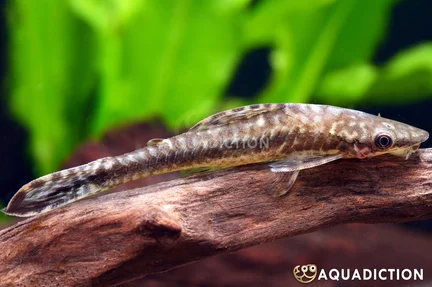
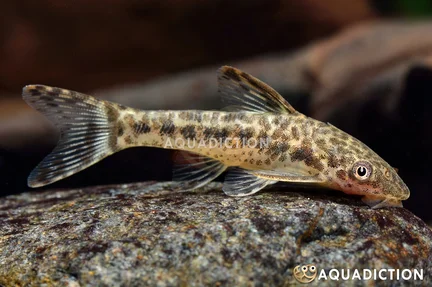
The Vampire Otocinclus (Nannoptopoma sternoptychum) is a small South American loricariid catfish native to South America. Despite the dramatic common name, it is not predatory and poses no threat to other fish. The nickname comes from its dark lateral stripe and facial markings, which give it a more striking, angular appearance compared with true Otocinclus species. Like its close relatives, it is a specialised periphyton grazer adapted to life clinging to submerged surfaces while feeding on biofilm, algae, and associated microorganisms.
The Vampire Otocinclus is highly social and should be kept in groups of 6 or more. In nature, these fish occur in loose aggregations, and this behaviour carries over into the aquarium, where grouped fish are noticeably more active, confident, and visible. Solitary individuals often become withdrawn and may struggle to compete for food. Within a group, interactions are peaceful and limited to subtle spacing rather than aggression, making shoal-style housing essential for long-term wellbeing.
The Vampire Otocinclus is a peaceful community fish and is best combined with calm, non-aggressive species that will not harass it or outcompete it for food. Suitable tankmates are small to medium-sized fish that occupy the midwater or upper levels and tolerate similar water conditions. Aggressive, boisterous, or substrate-dominating species should be avoided, as should large algae-eating fish that may deprive them of grazing opportunities. Invertebrates such as shrimp are generally compatible, provided water quality is maintained at a high standard.
A mature, well-established aquarium is essential for this species. Vampire Otos rely heavily on naturally occurring biofilm and soft algae growing on hard surfaces, so newly set-up tanks rarely provide adequate nutrition. The aquarium should include smooth rocks, driftwood, and other surfaces for grazing, along with stable water parameters, good filtration, and gentle to moderate water movement. While it tolerates a range of soft to moderately hard water, pristine conditions are critical, with consistently low nitrate levels and high dissolved oxygen. Supplemental foods such as algae-based wafers or gels can be offered, but they should support rather than replace natural grazing opportunities.
Availability
The Vampire Otocinclus isn't avilable any of our marketplace shops, want to be the first to offer it?.
Photos


Sexual Dimorphism
Sexual dimorphism in the Vampire Otocinclus is subtle and not reliably expressed through colour or pattern, making visual sexing difficult in both aquarium and field settings. Males and females share the same overall body shape, markings, and colouration, with no consistently documented differences in finnage or pigmentation. As with many small loricariids, any sexual distinctions are believed to be largely internal or size-related, with mature females potentially appearing slightly fuller-bodied when carrying eggs. However, this is not a dependable or always observable trait.
Quick Facts
| Scientific Name | Nannoptopoma sternoptychum |
|---|---|
| Year Described | 1996 |
| Kingdom | Animalia |
| Classification | Actinopterygii |
| Order | Siluriformes |
| Family | Loricariidae |
| Genus | Nannoptopoma |
| Origins | Ecuador Peru Bolivia |
| Approx Max Size | 3.3 cm |
| Temperament | Peaceful |
| Aquarium Level | All Levels |
| Difficulty | Beginner - Intermediate |
| Shoaling | NA |
| Best kept as | Groups 6+ |
| Diet & Feeding | Omnivore |
| Reproduction | Egg Depositor |
| Average Lifespan | Up to 5 Years |
Water Parameters
| Water Type | Freshwater |
|---|---|
| pH | 6.0 - 7.5 |
| GH | 2 - 10 |
| KH | 1 - 6 |
| TDS | 50 - 180 |
| ℉ | 72 - 81 |
|---|---|
| ℃ | 22 - 27 |
Natural Habitat
The Vampire Otocinclus is native to South America, occurring in tributaries of the upper Río Amazonas in Ecuador and Peru, as well as the central Río Amazonas, including the upper Río Madeira basin in Bolivia and Peru. Across this range, it inhabits clear to slightly turbid rivers and streams with steady flow, where submerged wood, stones, and leaf litter provide extensive surfaces for biofilm growth. These environments are typically well oxygenated and subject to seasonal fluctuations in water level, which shape both feeding opportunities and movement patterns. The species’ distribution reflects its close association with periphyton-rich habitats rather than still waters, favouring structurally complex margins and shallow runs where grazing surfaces are abundant and current prevents excessive sediment accumulation.
Breeding
The breeding behaviour of the Vampire Otocinclus remains poorly documented, and there are no verified reports of successful captive breeding. What is known is inferred from observations of closely related small loricariid catfish. Spawning is believed to involve the deposition of adhesive eggs on solid surfaces, such as smooth rocks, plant leaves, or hard décor, rather than egg scattering in open water. Fertilisation is external, and there is no evidence of parental care beyond site selection.
In the wild, reproduction is likely seasonally triggered, associated with fluctuations in water level, temperature, and flow that accompany Amazonian rainfall cycles. These environmental cues are extremely difficult to replicate accurately in aquaria, which is thought to be a key reason breeding has not been achieved or documented in captivity. As with many specialised periphyton-grazing loricariids, stable conditions that suit long-term maintenance do not necessarily align with those required to stimulate spawning behaviour. As a result, all individuals encountered in the aquarium trade are currently assumed to be wild-caught, and breeding this species should be regarded as unproven rather than impossible, pending future field observations or controlled studies.
Diet & Feeding
The Vampire Otocinclus is a specialised periphyton grazer, feeding primarily on biofilm, soft algae, and the microscopic organisms associated with these growths in its natural habitat. In the wild, it spends much of the day attached to hard surfaces such as rocks, wood, and submerged structures, rasping at the thin algal films and microbial layers rather than consuming coarse algae or higher plants. This grazing strategy is typical of small loricariids adapted to nutrient-poor waters where food is spread thinly over large surface areas.
In the aquarium, long-term success depends on providing a mature system with established biofilm, as newly set-up tanks rarely supply sufficient natural forage. While they will accept supplementary foods, these should be algae-based and fine-textured, such as high-quality spirulina wafers, algae gels, or powdered foods designed for biofilm grazers. Meaty foods are not a natural part of their diet and, if taken at all, should be offered only incidentally rather than routinely. Consistent access to grazing surfaces and excellent water quality are more important than heavy feeding, as overfeeding can quickly degrade conditions for this sensitive species.
Other Otocinclus



Published: 05 Feb 2026
Last Updated: 05 Feb 2026