

Bumblebee Otocinclus - Rhinotocinclus isabelae Fish Profile & Care Guide
Introduction
The Bumblebee Otocinclus (Rhinotocinclus isabelae), a rare and visually striking freshwater fish, has captured the fascination of hobbyists since its formal classification in 2022. However, prospective keepers should exercise caution, as these fish require experienced care due to their sensitive nature. Ideally suited for nano-sized tanks, provided they are devoid of aggressive or predatory tankmates, the Bumblebee Otocinclus thrives in peaceful aquatic environments. Despite their diminutive size, these fish exhibit remarkable activity, utilizing their specialized mouths to graze on algae spread throughout the aquarium. While some aquarists may find their habit of attaching to the glass displeasing, others appreciate their presence as a focal point in the aquarium.
Bubblebee Otocinclus prefers to stick together in groups and feed on the same area, so keeping them in groups of at least six is advisable. Of course, the larger the group, the better, but the aquarium must be large enough to accommodate them comfortably. These petite fish are vulnerable to larger or more aggressive species like Cichlids and Oscars. Therefore, it is wise to steer clear of species with a reputation for ferocity or a mouth big enough to swallow an Oto whole. Some popular tank mates for the Common Otocinclus include medium-sized Barbs, Corydoras Catfish, Angelfish, Danios, Dwarf Gourami, Rasboras, Guppies, Tetras, Mollies, and Zebra Loaches.
For optimal care of Bumblebee Otocinclus, an aquarium of at least 25 liters in size is recommended. Before introducing these fish into your aquarium, ensure that the tank is well-established and fully cycled. Bumblebee Otocinclus prefers mild levels of water flow and benefits from the presence of an additional powerhead or a filter that generates some current. To meet their warm-temperature requirements, maintain a reliable heater set between 71-79°F.
It is essential to provide plenty of natural plants and driftwood in the aquarium to mimic the species' native habitat. Suitable plant options include Anubias, Taiwan Lilies, and Rotala species. Various types of driftwood not only enhance the aesthetic appeal but also offer ample surface area for algae growth, a significant component of the Bumblebee Otocinclus diet. While regular water changes are necessary, avoid sudden fluctuations in water chemistry, as they can adversely affect the health of these sensitive fish. When performing water changes, do so gradually to allow adequate acclimation time for the fish.
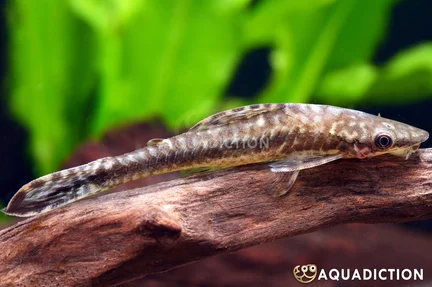
Renowned for their captivating appearance, Bumblebee Otocinclus are characterized by their rhinoceros-like facial features, reflected in their scientific name, Rhinotocinclus. Resembling larger plecos such as the Green Phantom, these Otos boast a prominent dorsal fin adapted to reduce water resistance. Their predominantly dark-colored bodies are adorned with thick white bands of varying widths, accompanied by iridescent off-white speckles that extend onto the dorsal fin. Notably, they possess an adipose fin and exhibit a distinctive Y-shaped light mark extending from the snout tip to each nostril, as well as a triangular dark spot on the anterior portion of the dorsal fin membrane.
Availability
The Bumblebee Otocinclus isn't avilable any of our marketplace shops, want to be the first to offer it?.
Photos

Sexual Dimorphism
Distinguishing between male and female Bumblebee Otocinclus requires careful examination, particularly of their pelvic fins. Typically, males exhibit larger pelvic fins compared to females. Additionally, astute aquarists may observe that males possess an elevated snout, attributed to a larger olfactory organ responsible for the species' sense of smell.
Quick Facts
| Scientific Name | Rhinotocinclus isabelae |
|---|---|
| Year Described | 2022 |
| Other Names | Bumble Bee Oto, Isabel's Rhinotocinclus |
| Kingdom | Animalia |
| Classification | Actinopterygii |
| Order | Siluriformes |
| Family | Loricariidae |
| Genus | Rhinotocinclus |
| Origins | Peru |
| Approx Max Size | 2 cm |
| Temperament | Peaceful |
| Aquarium Level | Bottom |
| Difficulty | Intermediate - Advanced |
| Shoaling | Yes |
| Best kept as | Groups 6+ |
| Diet & Feeding | Omnivore |
| Reproduction | Egg Depositor |
| Average Lifespan | Up to 5 Years |
Water Parameters
| Water Type | Freshwater |
|---|---|
| pH | 6.5 - 7.5 |
| GH | 5 - 12 |
| ℉ | 71 - 79 |
|---|---|
| ℃ | 22 - 26 |
Natural Habitat
Regrettably, limited information exists regarding the natural habitat of the Bumblebee Otocinclus; however, records indicate their presence in two localities near Iquitos, Loreto, Peru in South America. These habitats include the Río Nanay and the Río Tigre, where the Otocinclus is found in slow-moving to stagnant waters, predominantly rivers and small streams.
Breeding
Breeding Bumblebee Otocinclus presents a challenge, particularly for novice aquarists. Successful breeding requires considerable experience and meticulous attention to water quality and parameters. A dedicated breeding tank is essential, equipped with appropriate filtration and heating systems to regulate water conditions. It's advisable to opt for a low-flow filter in the breeding tank, as a high flow rate may adversely affect the integrity of the eggs' outer shells.
Diet & Feeding
Bumblebee Otocinclus exhibits a primarily herbivorous diet in its natural habitat, feeding predominantly on algae and biofilm that accumulates on submerged surfaces. In aquarium settings, these fish should be offered a varied diet consisting of algae wafers, sinking pellets, blanched vegetables such as zucchini or spinach, and occasional live or frozen foods like bloodworms or brine shrimp to ensure optimal nutrition. Additionally, providing ample driftwood and surfaces for algae growth within the aquarium mimics their natural foraging behavior, promoting their overall health and well-being. Regular feeding schedules and monitoring of their dietary intake are essential to support their dietary requirements and maintain their vibrant appearance in captivity.
Other Otocinclus




Published: 27 Feb 2024
Last Updated: 27 Feb 2024