

Bird Song Goby - Stiphodon surrufus Fish Profile & Care Guide
Introduction
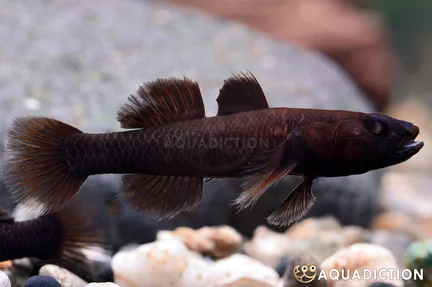
The Bird Song Goby (Stiphodon surrufus) is a tiny cling Goby adapted to life in high-oxygen, fast water. The male Bird Song Goby displays a striking, intense orange colouration across the body, complemented by a distinct orange ring encircling the eyes, giving the species a particularly eye-catching appearance. Females are almost transparent, with slightly dusky markings. These Gobies have an amphidromous life cycle, meaning the larvae develop in the sea before returning upstream.
The Bird Song Goby is not a “shoaling” fish, but it is distinctly social for a Goby and is usually most settled when kept in a small group. In a proper stream-style set-up, they often rest together on smooth stones with heads facing into the current, and you will see subtle social spacing and display behaviour rather than constant hiding. Males can be competitive with each other in tighter quarters (especially around prime perching spots or when in breeding condition), so group dynamics are best when sight lines break up plenty of rock surface.
Choose peaceful tankmates that enjoy similar cool-to-warm, highly oxygenated conditions and will not outcompete them for grazing areas. Avoid boisterous, fast-feeding fish that constantly pester the substrate, and be cautious with other strong aufwuchs grazers if the aquarium is not mature enough to provide continuous natural grazing. Calm, small fish that stay in midwater, along with invertebrates like shrimp, are usually a better match than pushy bottom-dwellers.
To successfully house Bird Song Gobies, aim for very clean, well-oxygenated water with steady flow, plenty of rounded rocks and boulders, and bright lighting that encourages biofilm and soft algae growth on surfaces. A mature tank is essential, because these gobies naturally pick at the micro-life associated with algae and biofilm rather than “mowing” algae like a true clean-up crew, so newly set-up aquariums often fail them due to a lack of established grazing. Keep filtration strong, add extra circulation if needed, and prioritise stability over chasing exact numbers; typical community-stream ranges are often around mildly acidic to neutral water.
Availability
The Bird Song Goby isn't avilable any of our marketplace shops, want to be the first to offer it?.
Photos


Sexual Dimorphism
Sexual dimorphism in the Bird Song Goby is marked and readily observable, and it follows the general pattern seen across the Stiphodon genus, where sexes are easy to distinguish by colour and contrast. In this species, males are vividly coloured, with bright red bodies and a contrasting blue head, features that likely play a role in social displays and male-to-male interactions. Females, on the other hand, are much less conspicuous, displaying an almost transparent body with slightly dusky or subdued markings rather than the intense hues of males. This stark difference in colouration not only aids visual sexing in both field and aquarium settings but also reflects typical sexual dimorphism in Stiphodon gobies, in which males invest in bright pigmentation and sometimes extended finnage to attract females and establish territories, while females remain cryptic.
Quick Facts
| Scientific Name | Stiphodon surrufus |
|---|---|
| Year Described | 1995 |
| Other Names | Emerald Cling Goby |
| Kingdom | Animalia |
| Classification | Actinopterygii |
| Order | Gobiiformes |
| Family | Oxudercidae |
| Genus | Stiphodon |
| Origins | Philippines |
| Approx Max Size | 2 cm |
| Temperament | Peaceful |
| Aquarium Level | Bottom - Middle |
| Difficulty | Beginner - Intermediate |
| Shoaling | NA |
| Best kept as | 3 Females per Male |
| Diet & Feeding | Omnivore |
| Reproduction | Egg Depositor |
| Average Lifespan | Up to 5 Years |
Water Parameters
| Water Type | Freshwater |
|---|---|
| pH | 6.5 - 7.5 |
| GH | 2 - 12 |
| KH | 3 - 10 |
| TDS | 50 - 150 |
| ℉ | 72 - 82 |
|---|---|
| ℃ | 22 - 28 |
Natural Habitat
The Bird Song Goby is a freshwater Goby with an exceptionally restricted natural range, endemic to the Philippines, and only known with confidence from Lagu Lagu Creek on Leyte Island in the central Philippines. In its native habitat, it is found in clear, swift-flowing stream sections with abundant boulders and rocky substrates, where high dissolved oxygen and unbroken current are the norm. The adults cling to stones in shallow runs and riffles, utilising their pelvic suction discs to hold position against the flow while they graze on micro-films and algae that coat the submerged surfaces. This highly specialised stream biotope reflects the species’ adaptation to torrential headwater environments rather than still waters or broad floodplain rivers.
Breeding
The breeding biology of the Song Bird Goby has not been directly documented under controlled conditions, and no successful captive rearing of fry has been reported for Stiphodon species to date, making detailed husbandry breeding guides largely speculative. However, what is well established for Stiphodon Gobies in general is their amphidromous reproductive strategy: adults spawn in clear, fast-flowing freshwater, where fertilised eggs adhere to hard substrates, such as rock undersides. After hatching, the minute larvae are immediately carried downstream by currents into the marine environment, where they remain in the plankton for an extended period (often many weeks) before undergoing metamorphosis and returning upstream to freshwater as juveniles. This downstream drift stage and subsequent marine development phase are essential components of their life cycle and a major reason captive breeding has been so elusive, as recreating the hydrological gradient between freshwater and sea in an aquarium setting is extremely challenging. Studies of related Stiphodon species confirm this amphidromous pattern: larvae survive and develop only if transported to the ocean before they exhaust their yolk reserves, and later use physiological cues to migrate back into natal streams.
Diet & Feeding
Bird Song Gobies are specialised benthic grazers that feed primarily on algae, biofilm and the associated microorganisms on submerged surfaces in their native fast-flowing streams. Their subterminal, extrusible mouthparts are adapted to scrape aufwuchs off rocks and stones, allowing them to exploit microscopic plant and microbial growth that accumulates in well-oxygenated water. This grazing behaviour mirrors that documented for other Stiphodon species, which rely on a continuous supply of natural algal films for most of their nutrition in the wild.
In aquarium settings, providing a well-established, mature tank is crucial because these fish will naturally pick at biofilm and algae rather than actively chase large food items. Enthusiasts and care guides report that Stiphodon gobies will also accept supplementary foods such as high-quality sinking algae wafers, spirulina-based tablets, blanched vegetables (e.g., cucumber or zucchini slices), and prepared gel foods formulated for herbivorous species, especially when natural grazing options are limited. Although primarily grazers, certain individuals will sporadically sample small portions of frozen or live foods, most commonly baby brine shrimp or bloodworms. Still, these should be offered sparingly and not as a primary diet, since their digestive tracts are predominantly adapted to processing plant-based material and associated microbes.
Other Gobies


Published: 05 Feb 2026
Last Updated: 05 Feb 2026