

Annie's Goby - Stiphodon annieae Fish Profile & Care Guide
Introduction
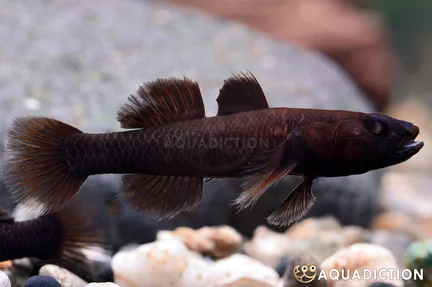
The Annie's Goby (Stiphodon annieae) stands out as an exceptionally rare species within the Dwarf Goby family, distinguished by the male's striking neon red and blue colouration. Females, while less vivid, also possess attractive markings. This peaceful species, primarily an algae and biofilm grazer, emerges as an ideal inhabitant for well-established nano aquariums. Annie's Gobies display unique social dynamics, with males generally adopting a solitary lifestyle, whereas females tend to form loose aggregations. Consequently, an optimal aquarium configuration would entail housing a single male alongside two or more females.
In captivity, selecting compatible tank mates for Annie's Gobies is vital to fostering a cohesive community. They coexist peacefully with species favouring similar environmental conditions, especially those adapted to brisk, oxygen-rich waters. Suitable companions include small Rasboras, Tetras, Hillstream Loaches, and other non-aggressive fish. While Annie's Dwarf Gobies can cohabit with Dwarf Shrimp, there is a potential for the occasional consumption of shrimp fry. Compatibility with peaceful, bottom-dwelling species is feasible, provided there is no competition for food. It is recommended to avoid larger, predatory, or highly active fish that may intimidate or stress the Gobies.
An ideal habitat for Annie's Dwarf Gobies mimics their natural preference for strong water flow and pristine conditions. These fish are susceptible to water quality deterioration, necessitating diligent aquarium upkeep. They thrive in environments abundant with hiding spots like crevices, caves, and small openings for territory establishment. Though not critical for their survival, Annie's Gobies enjoy burrowing in fine sand, a behaviour that complements their natural inclinations. Their gentle burrowing habits make them compatible with planted aquariums, as they often partially bury themselves, leaving only their heads and tails exposed.
Availability
The Annie's Goby isn't avilable any of our marketplace shops, want to be the first to offer it?.
Photos

Sexual Dimorphism
Annie's Gobies display pronounced sexual dimorphism, especially during the breeding season. Males exhibit more vivid colouration than females, with enhanced and brighter hues significant in courtship behaviours. Additionally, males possess slightly more extensive and more elaborate fins, utilized both to attract mates and assert dominance over rivals. In contrast, females feature more muted colour schemes and lack the extravagant finnage observed in males. Typically, females are slightly larger in body size, a trait particularly noticeable when gravid, signalling their preparedness for spawning.
Quick Facts
| Scientific Name | Stiphodon annieae |
|---|---|
| Year Described | 2015 |
| Other Names | Annie's Dwarf Goby |
| Kingdom | Animalia |
| Classification | Actinopterygii |
| Order | Gobiiformes |
| Family | Oxudercidae |
| Genus | Stiphodon |
| Origins | Indonesia |
| Approx Max Size | 3 cm |
| Temperament | Peaceful |
| Aquarium Level | Bottom |
| Difficulty | Beginner - Intermediate |
| Shoaling | NA |
| Best kept as | 2 Females per Male |
| Diet & Feeding | Omnivore |
| Reproduction | Egg Depositor |
| Average Lifespan | Up to 5 Years |
Water Parameters
| Water Type | Freshwater |
|---|---|
| pH | 6.5 - 7.5 |
| GH | 2 - 12 |
| TDS | 50 - 180 |
| ℉ | 60 - 75 |
|---|---|
| ℃ | 18 - 24 |
Natural Habitat
The Annie's Goby is native to Halmahera in Indonesia, located within the biodiverse realm of Southeast Asia. This species is adapted to dwell in clear, fast-flowing streams characterized by steep gradients and rocky substrates. In their natural habitat, Annie's Gobies are benthic, predominantly residing on and among the rocks at the riverbed, where they play a vital role in the ecosystem.
Breeding
Sexually mature Annie's Gobies reproduce within freshwater streams. The resulting larvae, upon hatching, are at an initial stage of development and are not sufficiently mature enough to be deemed fry. These early-stage larvae are then transported downstream to the ocean, becoming part of the planktonic community. Within this marine setting, they exist on a diverse array of microorganisms undergoing a significant phase of growth and development. Subsequently, these juvenile fish embark on a migratory return to freshwater, completing the cycle by returning to their natal streams.
Diet & Feeding
Annie's Gobies are known for their preference for biofilm and algae, which they graze on rocks and substrate surfaces. In captivity, replicating this diet requires providing a variety of algae-based foods, such as spirulina wafers and blanched vegetables, to simulate their natural alimentary intake. Additionally, supplementing their diet with live or frozen foods, such as daphnia or brine shrimp, can enhance nutritional diversity and promote optimal health.
Other Gobies


Published: 02 Apr 2024
Last Updated: 02 Apr 2024