

Bereme Creek Goby - Sicyopus beremeensis Fish Profile & Care Guide
Introduction
The Bereme Creek Goby (Sicyopus beremeensis) is a small, benthic freshwater goby endemic to Papua New Guinea. Described relatively recently, this striking species is primarily found in fast-flowing mountain streams and is known for its vivid colouration and distinctive banding, especially in males. As part of the Sicydiinae subfamily, it exhibits a remarkable life cycle that includes a marine larval stage, making its ecological niche and care requirements unique among freshwater fish.
These gobies are not shoaling fish in the traditional sense but may be found in loose aggregations in the wild, particularly in suitable microhabitats with clean, oxygen-rich water and smooth substrates. In captivity, they typically exhibit a solitary or mildly territorial nature, with males displaying dominance during feeding or courtship displays. They are best kept either singly or in small groups with careful attention to space and habitat layout. Males can be territorial, especially during feeding or courtship, so it is essential to provide ample hiding spots and visual barriers such as smooth river stones and strong water flow to break lines of sight.
Due to their specific habitat needs and peaceful disposition, Bereme Creek Gobies are best kept with other small, non-aggressive species that thrive in similar conditions. Their generally peaceful nature ensures a harmonious coexistence with ideal companions such as other rheophilic gobies, hillstream loaches, or small cyprinids that can tolerate strong currents and do not compete aggressively for food or space. Avoid housing them with larger or boisterous fish, as they can easily become stressed or outcompeted.
Replicating their natural riverine habitat is essential for the well-being of Bereme Creek Gobies. These gobies require highly oxygenated, fast-moving water with plenty of flow, which is best achieved with strong filtration and current-producing equipment. The aquarium should feature smooth river rocks, rounded gravel, and well-aged surfaces for biofilm grazing. Clear, clean water with stable parameters is crucial, as this species is sensitive to poor conditions and sudden changes.
Availability
The Bereme Creek Goby isn't avilable any of our marketplace shops, want to be the first to offer it?.
Photos


Sexual Dimorphism
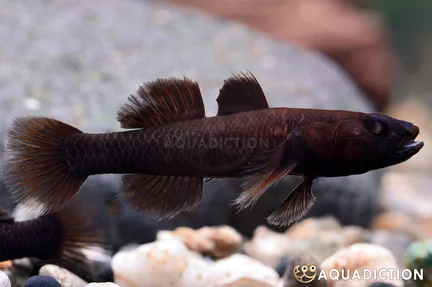
Bereme Creek Gobies are known for their striking sexual dimorphism. Males exhibit bold, contrasting colours with a jet-black head from snout to nape and vivid orange and black bands encircling the body. Their eyes have a black centre with a bright orange ring, and the caudal fin is edged with a subtle blue. The fins are primarily black or orange, with clearly defined borders and well-pigmented scales. Male colours become even more vibrant during courtship. Females have a more subdued appearance, featuring a brown to grey body, a dark brown head, and a prominent black stripe that extends from just below the eye to the base of the tail. Their fins are pale and translucent, except for the anal fin, which stands out in bright red.
Quick Facts
| Scientific Name | Sicyopus beremeensis |
|---|---|
| Year Described | 2019 |
| Other Names | Papua Striped Goby |
| Kingdom | Animalia |
| Classification | Actinopterygii |
| Order | Gobiiformes |
| Family | Oxudercidae |
| Genus | Sicyopus |
| Origins | Papua New Guinea |
| Approx Max Size | 6 cm |
| Temperament | Peaceful |
| Aquarium Level | Bottom |
| Difficulty | Intermediate |
| Shoaling | No |
| Best kept as | Groups 5+ |
| Diet & Feeding | Omnivore |
| Reproduction | Egg Depositor |
| Average Lifespan | Up to 3 Years |
Water Parameters
| Water Type | Freshwater |
|---|---|
| pH | 6.5 - 7.5 |
| GH | 4 - 10 |
| KH | 2 - 6 |
| TDS | 80 - 150 |
| ℉ | 72 - 79 |
|---|---|
| ℃ | 22 - 26 |
Natural Habitat
The Bereme Creek Goby is native to New Britain, Papua New Guinea. It inhabits clear, fast-moving mountain streams at altitudes ranging between 300 and 900 m with rocky bottoms and minimal vegetation. These ecosystems are highly oxygenated and nutrient-poor, favouring agile, benthic fish that can cling to surfaces in strong currents. As an amphidromous species, it relies on the connectivity between freshwater and marine environments, which plays a role in its life cycle and conservation needs.
Breeding
While breeding Bereme Creek Gobies in captivity is a goal for many enthusiasts, it is considered extremely challenging due to their amphidromous life cycle. In the wild, eggs are laid in freshwater, but the larvae are swept downstream to the ocean, where they develop before returning to freshwater habitats. Replicating this natural transition has not yet been reliably achieved in home aquariums, making captive breeding currently unfeasible.
Diet & Feeding
In the wild, the Bereme Creek Goby feeds on biofilm, algae, and small invertebrates found on submerged rocks. In captivity, they adapt to a varied diet of high-quality, finely crushed sinking foods, live or frozen microfauna such as daphnia and brine shrimp, and specialized algae-based wafers. A well-established aquarium with natural biofilm growth is highly beneficial to support their grazing behaviour.
Other Gobies


Published: 11 Jul 2025
Last Updated: 11 Jul 2025