
Orange Cherry Shrimp - Neocaridina davidi var. "Orange" Shrimp Profile & Care Guide
Introduction
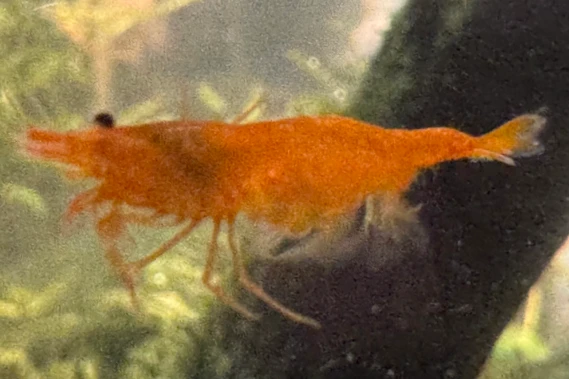
The Orange Cherry Shrimp (Neocaridina davidi) is one of the cutest little head-turners in the freshwater hobby. This bright orange colour is the result of selective breeding (they are not naturally neon in the wild), and it is exactly why they pop so nicely in planted tanks. The best part is they are hardy, adaptable, and very beginner-friendly, especially once the tank is mature and stable.
Orange cherries are peaceful, social little grazers that do best in a small group. They can live happily with snails and other calm tankmates, but they are at their most confident when they have plenty of cover - think moss, plants, wood, rocks, and tiny hidey-holes. When they feel safe, they spend far more time out on display, doing their adorable “busy shrimp” routine across the glass, plants, and hardscape.
They are also brilliant little clean-up crew members. Orange Neocaridina will happily pick at biofilm, soft algae, and leftover food, and you will often spot them gently combing through leaves like they are tidying up the place. They are very plant-safe (they do not eat healthy plants), and in a well-planted aquarium they help keep things looking fresh by grazing on the bits you would rather not see.
You will often notice them hanging around mosses and fine-leaved plants, and they also love areas with lots of surface growth and micro-food (floating plants can be a buffet zone because they trap tiny particles and biofilm underneath). Like most dwarf shrimp, they really appreciate clean, stable water - sudden swings are what upset them more than any single number. Keeping on top of maintenance and avoiding high nitrate is a good habit, because shrimp are much less forgiving than most fish when water quality slips.
When people talk about “grades”, it is mainly about colour depth and coverage. Higher-grade orange shrimp tend to be more solid and opaque, while lower grades may look paler or a bit see-through. It is worth remembering that grading is mostly about looks - a lighter shrimp is not automatically unhealthy, it is just less intensely coloured.
Availability
The Orange Cherry Shrimp is avilable from the following marketplace shops.
 Doras Aquatics Nyc
Photos

Sexual Dimorphism
Sexing Orange Cherry Shrimp (Neocaridina davidi) is a bit tricky when they are young, but it gets much easier once they are fully grown.
Females are usually the bigger, chunkier ones, with a rounder, curved underbelly (that “banana” shape helps them hold eggs). Many females also show a saddle behind the head - a lighter patch where developing eggs sit before they move down to be carried under the tail. Colour can be stronger in females, but that is not a guaranteed rule because colour depends on grade, diet, and the individual shrimp.
Males tend to be smaller and slimmer, with a straighter underside and a more streamlined look overall. They can sometimes look a bit paler too, but again, size and body shape are the most reliable giveaways.
If you are unsure, watching a group over time helps - once you spot your first berried female, the differences suddenly become very obvious.
Quick Facts
| Scientific Name | Neocaridina davidi var. "Orange" |
|---|---|
| Year Described | 1904 |
| Other Names | Orange Sunkist Shrimp |
| Kingdom | Animalia |
| Classification | Malacostraca |
| Order | Decapoda |
| Family | Atyidae |
| Genus | Neocaridina |
| Origins | |
| Approx Max Size | 3 cm |
| Temperament | Peaceful |
| Aquarium Level | Bottom |
| Difficulty | Beginner |
| Shoaling | No |
| Best kept as | Groups 10+ |
| Diet & Feeding | Omnivore |
| Reproduction | Ovoviviparous |
| Average Lifespan | Up to 2 Years |
Water Parameters
| Water Type | Freshwater |
|---|---|
| pH | 6.0 - 8.0 |
| GH | 4 - 8 |
| KH | 3 - 15 |
| TDS | 150 - 250 |
| ℉ | 68 - 78 |
|---|---|
| ℃ | 20 - 25 |
Natural Habitat
Breeding
Breeding Orange Cherry Shrimp (Neocaridina davidi) is one of the easiest and most rewarding things in the freshwater hobby. If you keep a mixed group in a stable, well-established tank with clean water and plenty of grazing surfaces, they often do the rest all by themselves.
When a female is ready, you will spot her carrying a clutch of eggs tucked under her tail, held safely on her little swimmerets. This is called being “berried”, and it is ridiculously cute. Depending on temperature and conditions, she will carry the eggs for roughly 3 to 4 weeks before the babies appear. The shrimplets hatch as tiny miniature versions of the adults, and they immediately start creeping around, grazing and hiding.
For the best survival rate, a mature aquarium is key. Newborn shrimplets spend most of their time picking at biofilm and micro-foods on plants, moss, wood, and sponge filters, so the more “grown-in” the tank looks, the better. Gentle filtration (like a sponge filter) and avoiding sudden changes help a lot, because babies are even more sensitive than the adults.
If you want to keep your orange line looking bright and consistent, it is usually best to keep one Neocaridina colour strain per tank. Different Neocaridina colour types will happily crossbreed, and the offspring can trend back towards duller, more wild-type colouring over time. It does not always happen instantly, but mixing strains generally reduces colour quality across future generations.
Diet & Feeding
Orange Cherry Shrimp (Neocaridina davidi) are cheerful little omnivores that will happily munch their way through whatever tasty bits the tank provides. Most of the day they are busy grazing on biofilm, soft algae, and aufwuchs from leaves, wood, rocks, and even the glass - like tiny underwater cleaners with antennae.
If your aquarium is very clean (or new) and there is not much natural grazing, it is a good idea to offer extra food. A quality shrimp pellet/granule, sinking wafers, or an algae-based food makes a great staple. You can also treat them occasionally with a small amount of protein food (shrimp-specific foods often include this already). If you do add frozen foods, keep it light, and pick options shrimp actually handle well.
A few shrimp favourites that usually go down a treat:
Blanched veg (courgette, spinach, cucumber, broccoli stem - tiny portions)
Dried leaf litter like Indian almond leaves (catappa), which also grows lovely biofilm
Mulberry/guava leaves if you use shrimp-safe ones
Little tip: shrimp do not need much food at all. It is better to feed small amounts and let them graze, rather than overdo it. Remove any uneaten food after a couple of hours (sooner if it is meaty), and a feeding dish is brilliant for keeping things tidy and stopping food from disappearing into the substrate.
Other Neocaridina


Published: 19 Dec 2024
Last Updated: 19 Dec 2025